dlin™ ecosystem
DLIN™ ECOSYSTEM:
THE DECENTRALIZED INFRASTRUCTURE ECONOMY
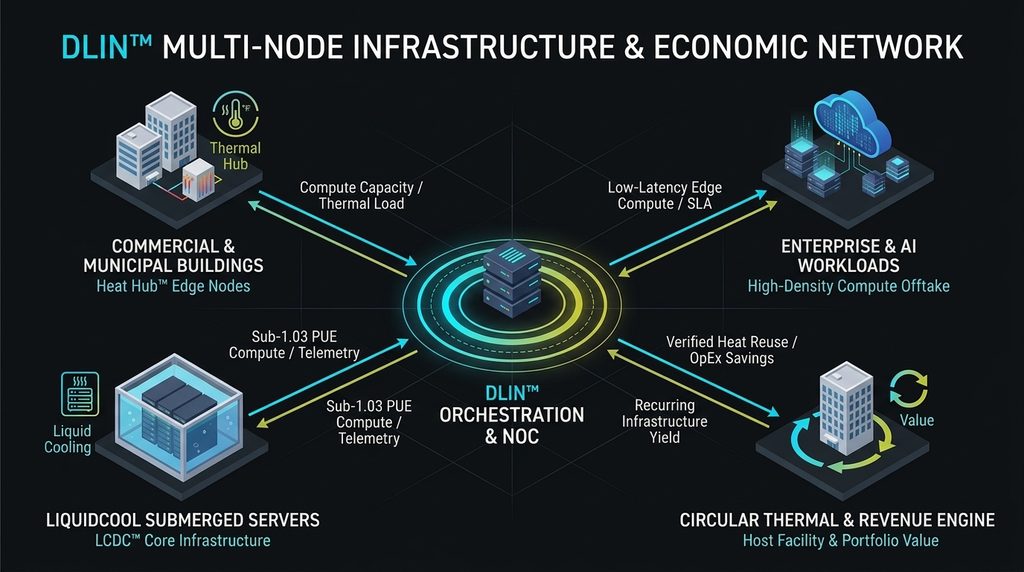
We built the Decentralized Local Infrastructure Network (DLIN™) to turn standalone Heat Hubs™ into an interconnected, regional digital utility fabric—linking qualified commercial, municipal, and utility-connected buildings into a single, orchestrated edge compute and thermal recovery grid. Instead of sinking hundreds of millions of dollars into greenfield land, multi-year utility queues, and conventional chiller plants, we deploy modular, high-density LiquidCool Submerged Server (LSS) nodes directly inside existing building mechanical rooms. From our Network Operating Center (NOC), we dynamically balance enterprise and AI compute workloads against each host facility’s live thermal demand—eliminating district piping overhead while turning idle square footage into active infrastructure.
Operating as an affiliated, licensed-IP distributor of LSS technology, Fiberoptiq pairs disciplined operational execution with capital-efficient infrastructure economics across domestic real estate portfolios. Every connected node unlocks dual-sided value: enterprise clients gain ultra-low-latency, sub-1.03 PUE edge compute, while building owners capture verified waste-heat reuse, lower mechanical OpEx, and recurring network yield. By scaling incrementally node by node as demand grows, DLIN™ bypasses speculative mega-campus CapEx and transforms distributed urban buildings into a resilient, revenue-generating compute grid.
Core Economics: Transforming qualified commercial, municipal, and utility-connected buildings from isolated energy consumers into a DLIN™.
The 3-Pillar Value Engine
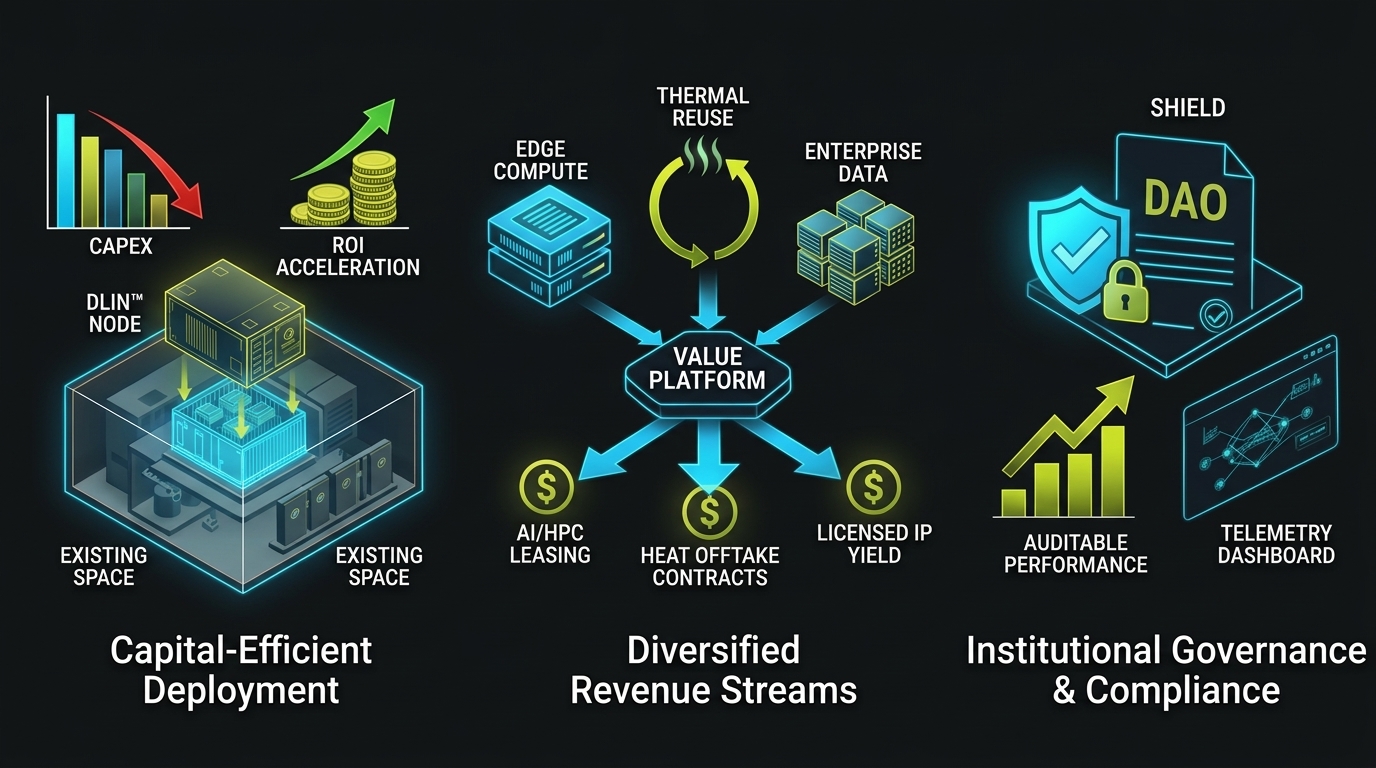
Capital-Efficient Deployment
Conduct multipoint Distribution of Proof-of-Concept (PoC) channel operations to scale or retrofit existing mechanical rooms in 4–12 months vs. multi-year Greenfield Project.
Diversified Revenue Streams
Compute leasing, energy/thermal optimization, enterprise/government contracts, and licensed-IP deployment.
Institutional Governance & Compliance
Carrier-grade 95%+ uptime standards, cybersecurity controls, telemetry, and decentralized autonomous organization alignment.